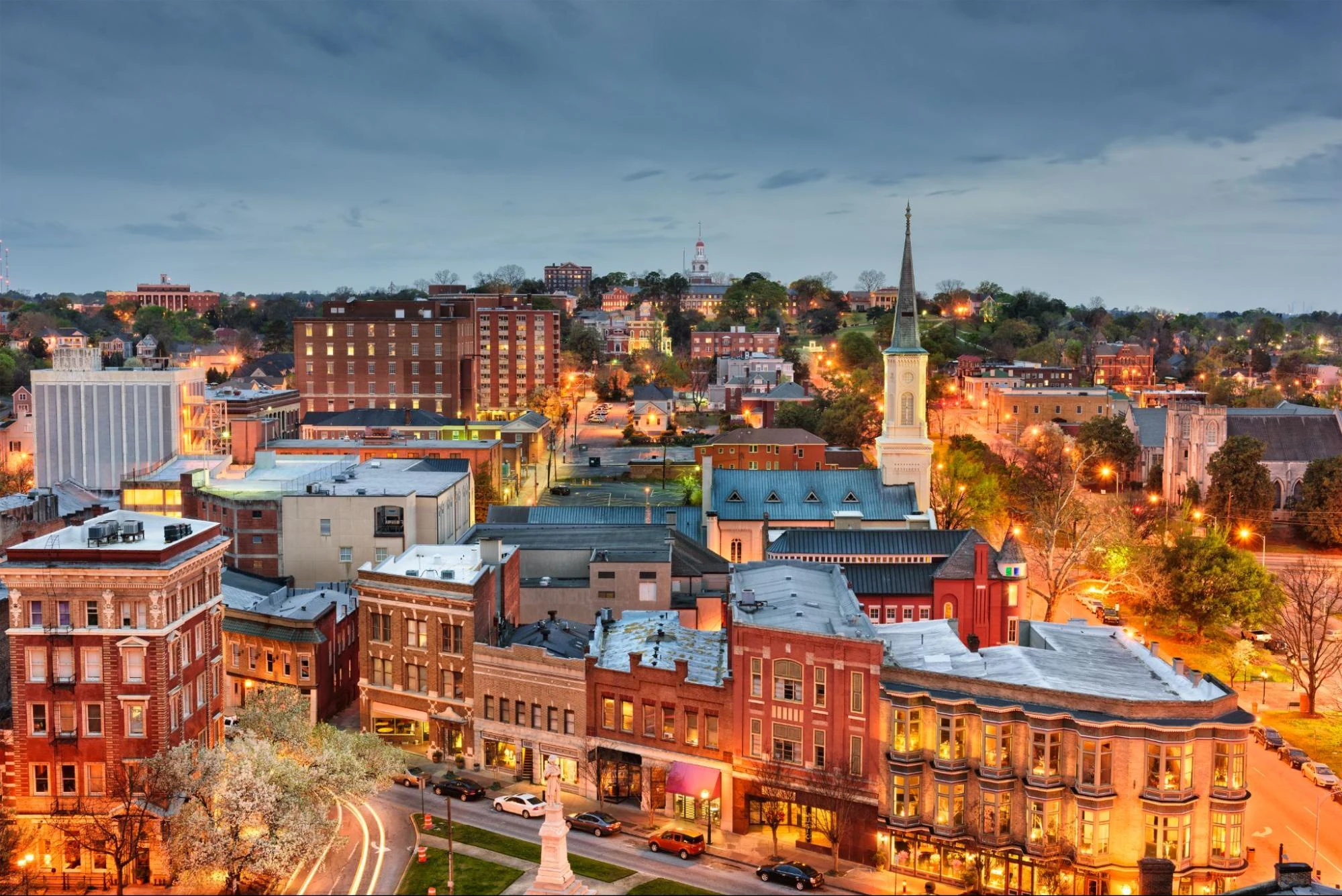
For commercial properties in Downtown Macon, GA, the defensible choice between repair, restoration, and replacement starts with roof-system condition, moisture findings, drainage performance, and remaining service life. Downtown Macon carries the oldest commercial building stock in the metro , office buildings, hotels, and entertainment venues built across more than a century, many with roof configurations that don't match a typical suburban low-slope scope. Roofing work down here means working around historic construction, tenant occupancy, and event schedules all at once.
Downtown Macon's office buildings range from early-1900s masonry construction with built-up roofing to mid-century additions with their own membrane systems layered on top over the decades. We start every downtown project with a roof history review where records exist, since these buildings often have multiple roof systems stacked from past recover projects rather than a single clean assembly.
Occupied office buildings downtown require access planning that respects tenant business hours and building security, and we coordinate elevator or hoist access with property management well ahead of any material delivery.
Street-level material staging is tighter downtown than in a suburban office park, with limited curb space and pedestrian traffic to account for, so we plan delivery timing and crane or hoist placement in advance rather than improvising on the day of the job.
Downtown's hotels run continuous guest occupancy, which means roof work has to account for noise limits, guest room proximity to the roof deck, and a strict no-leak tolerance during a stay. We schedule loud phases of a project , tear-off, fastening , during hours that minimize guest disruption where the hotel's operations team can accommodate it, usually working from a schedule the hotel's general manager reviews and approves in advance.
Hotel roofs also carry rooftop mechanical for HVAC serving individual guest room zones, and a failure there affects comfort in specific rooms rather than the whole building, which changes how we prioritize repair sequencing on these properties.
Rooftop amenity spaces, where a hotel has built out a bar or event deck on part of the roof, add foot traffic and furniture loads the original roof design may not have anticipated, and we inspect those areas for wear patterns distinct from the rest of the membrane field, particularly around planter boxes and furniture footings.
The theaters and entertainment venues downtown operate on a performance and event calendar that doesn't tolerate a roof leak during a show, and these buildings often have complex rooflines with fly towers, marquees, and mixed flat and sloped sections. We schedule inspection and non-emergency work around the published event calendar and treat any active leak near a stage or seating area as a priority call.
Some of these buildings carry historic designation, which affects what changes are visible from the street and may require specific documentation for any exterior work, including roof edge and parapet details.
Multi-story downtown buildings rely heavily on internal drains and scuppers rather than roof edge runoff, and a clogged internal drain on one of these buildings can back water up against a parapet wall fast during a heavy Georgia thunderstorm. We treat internal drainage inspection as a priority item on every downtown roof we service, not an afterthought to the membrane itself.
The commercial properties bordering Mercer University's downtown-adjacent campus include a mix of office buildings, medical and professional space, and small retail that leases in part to the university community. Roof projects on these buildings sometimes need to work around the same academic-calendar considerations as campus buildings proper, since a landlord serving university tenants often prefers work scheduled outside the fall and spring semester crunch.
We treat these properties as their own category rather than folding them into either the pure office or pure campus bucket, since the tenant mix and access requirements are genuinely different from either a standard downtown office building or a university-owned facility, and a proposal written for one rarely fits the other cleanly without real adjustment to the scheduling assumptions behind it.
We start with a roof history review where records exist, then confirm current conditions on site, since layered downtown roofs often need a different tear-off or recover approach than a single clean system.
We schedule the loudest phases of a project during hours the hotel's operations team identifies as lowest-impact, and we coordinate closely to keep disruption to a minimum.
Yes. We plan inspection and non-emergency work around the published event schedule and treat any leak near a stage or seating area as a priority repair.
Buildings with historic designation can require documentation showing exterior changes stay within guidelines, particularly for anything visible from the street, and we prepare that documentation as part of the project.
Multi-story buildings here rely on internal drains and scuppers rather than roof-edge runoff, and a clog can back water against a parapet quickly during a heavy storm, so we prioritize that inspection.