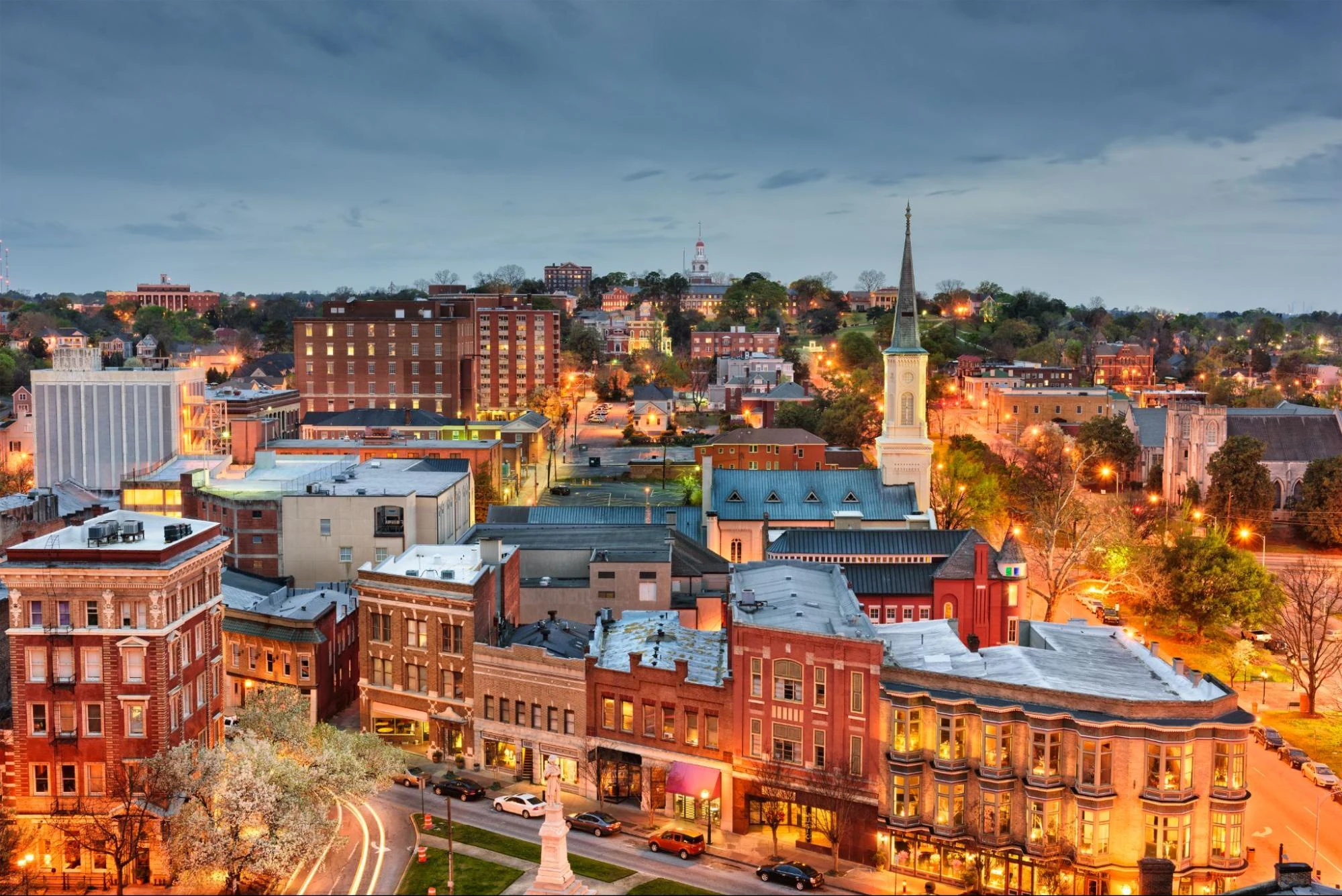
Commercial roofers serving Knoxville, GA should document leak sources, wet insulation, drainage, edge details, penetrations, and repair history before recommending a scope. Knoxville is the seat of Crawford County, and it is genuinely small: a courthouse, a handful of county offices, a couple of churches, and a few small businesses around the square. We're upfront that this is not a commercial market with a real estate pipeline behind it, and we scope roofs here on that honest basis.
Knoxville's roof stock is short: the county courthouse and an adjacent administration building, a volunteer fire department structure, a farm and feed supply store, and church buildings that serve much of the town's civic function alongside worship. There's no strip retail center or industrial park to point to, and we don't pretend otherwise in a proposal or on this page. What's here is what we bid.
We say this plainly because it changes how a proposal should read. A five-page bid package written for a distribution center doesn't belong on a courthouse annex with two roof planes, and padding a Knoxville scope with sections that don't apply just makes the document harder for a small facilities office to use. We keep proposals here as short as the building calls for.
That small inventory still needs the same attention a larger roof would get. A courthouse roof failure in a town this size is a bigger disruption proportionally than a leak in one bay of a big-box store elsewhere, because there's no redundant building to shift operations into while repairs happen.
Crawford County's courthouse and administration buildings are the largest roofing assets in Knoxville, and public work here runs through the same bid and documentation process smaller Georgia counties typically require. We prepare submittals, warranty terms, and a schedule that respects courthouse hours, sized to a county this size rather than padded to look like a bigger job than it is.
Because the county likely has one person managing facilities across several responsibilities, we write our reports and proposals in plain language, not roofing jargon that requires a specialist to interpret.
Access to a courthouse roof in a town this size can also mean working around a single public entrance and limited staging area on the square itself. We plan material delivery and lift placement to keep the courthouse functioning during business hours, since there's no separate loading dock or back-of-house route to use instead, and we coordinate directly with the clerk's office on timing rather than assuming access is unrestricted.
Knoxville's older buildings, including some of the church and civic structures, often carry roofs installed decades ago with limited maintenance history in between. Recover and coating options get more weight here than they might in a market with newer construction, because a targeted repair that extends service life is frequently the fiscally responsible call for a county or small congregation working with a limited budget. We put a realistic remaining-life estimate in writing so the decision isn't made blind.
Crawford County sees the same Middle Georgia summer pattern as its larger neighbors: heat, UV load, and thunderstorms that build fast in the afternoon. A town this size has less tree canopy over its roofs than a wooded rural crossroads might, so UV degradation on an older membrane tends to show up earlier here than debris-related drainage problems do.
Wind events from summer storms are the most common cause of the emergency calls we get from this part of the county, usually a lifted section of membrane or a torn flashing detail rather than structural damage. We treat those calls with the same urgency regardless of how small the building is, and we don't ask a small congregation or county office to wait behind larger commercial jobs on our schedule when a roof is actively leaking.
We don't write a bigger scope than a Knoxville roof needs just because a proposal looks more substantial that way. If a coating will genuinely extend a roof's life at a fraction of tear-off cost, that's what we recommend, and we say so plainly. Our silicone roof coating work is a common fit for buildings like these.
No. We size proposals to the actual building, whether that's a courthouse roof or a single small storefront.
Yes, including the documentation and prevailing-wage compliance that public procurement in Crawford County may require.
Often, yes, particularly on older civic or church roofs where the deck is still sound and budget is limited.
We prioritize any active leak the same way regardless of building size, starting with a temporary dry-in.
Yes, and we write proposals in plain terms for that kind of decision-maker rather than assuming a facilities department is involved.